

The Post-Traumatic Growth Process: Victim, Survivor, Hero
Author: Staci Rivera-Nichols – Trauma-Informed Marketing Strategist, Complex Trauma Consultant, and Marketing for Therapists Coach
Read Time: 15-20 minutes | Publication Date: October 28, 2025
Watch It on YouTube
Key Terms Defined
- Complex Post-Traumatic Stress Disorder (C-PTSD or Complex-PTSD): For the purposes of this article, the matrix version of the “survivor stage” or “hero stage” of trauma processing. C-PTSD is when the “broken-ness” of being traumatized lasts through the survivor stage.
- Complex Trauma: According to the National Child Traumatic Stress Network, “Complex trauma describes both children’s exposure to multiple traumatic events—often of an invasive, interpersonal nature—and the wide-ranging, long-term effects of this exposure. These events are severe and pervasive, such as abuse or profound neglect. They usually occur early in life and can disrupt many aspects of the child’s development and the formation of a sense of self.” 1 Additionally, complex trauma causes brain changes like an overactive amygdala and underactive hippocampus, along with cellular alterations involving immune cells, and stress hormone pathways.
- Logotherapy: Developed by concentration camp survivor and psychiatrist Viktor Frankl, defined by Wikipedia as “a concept based on the premise that the primary motivational force of an individual is to find meaning in life.”
- Post-Traumatic Growth: The result of passing through the dark tunnel of PTSD
- Post-Traumatic Stress Disorder (PTSD): For the purposes of this article, the state of people in the “survivor stage” of trauma processing. The term “Post-Traumatic Stress Injury” is preferred as it more accurately reflects the natural psychological bruising of being hit by trauma.
- Survivor: A survivor is someone who has started feeling what there is to feel–shame, pain, and anger.
- Trauma: Dr. Gabor Maté says, “Trauma is not what happens to you, but what happens inside you as a result of what happened to you.”
- Trauma Heroine (or Trauma Hero): A trauma heroine or hero has surrendered to all of their trauma, metabolized the entire experience, integrated it into their worldview, and undergone post-traumatic growth.
- Victim: A victim is someone who has experienced trauma, complex or otherwise. People in the victim stage are typically still in shock or denial and haven’t truly begun to process.
What Doesn’t Kill Us…
“Whether you can use your healing as an awakening process depends on the perspective from which you come at it.” -Ram Dass
Post-traumatic growth, especially from complex trauma, can be transformational. “Suffering is the short road to spirit,” is a common metaphysical saying. This means that suffering leads people quickly to connect with their own spirituality. If everything is fine all the time, where is the motivation to read books that give us new insights or to think in different ways? If we don’t know sadness, then we can not appreciate happiness. In fact, the first noble truth of Buddhism is that life is inseparable from suffering. This is the premise, the base of the entire Buddhism philosophy: life is pain.
Is suffering (trauma) therefore necessary for us to evolve? The most unanswerable question of the universe is why does God allow people to suffer. Is it possible that complex trauma and any type of suffering needs to exist as a catalyst for us to truly know ourselves? Without post-traumatic growth, does anyone ever become enlightened? Clearly, no God that any culture has ever conceived of wants anyone to hurt for the sake of hurting. Only one reason is big enough for any higher power to allow complex trauma, right? Suffering would have to be the oil keeping the entire machine grinding onward.
Unfortunately, this “necessity” needed for spiritual advancement is too much for many people. While it is crucial for personal evolution, post-traumatic growth is kryptonite to some. The good news is that, at any point, people can decide to master their own suffering. Anyone can do it. Maybe this article found you right now because post-traumatic growth is calling.
The Trauma Hero’s Journey
“It is so much easier to cause pain than to feel pain.” -Brené Brown
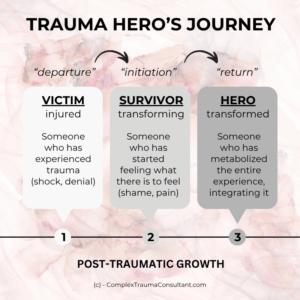
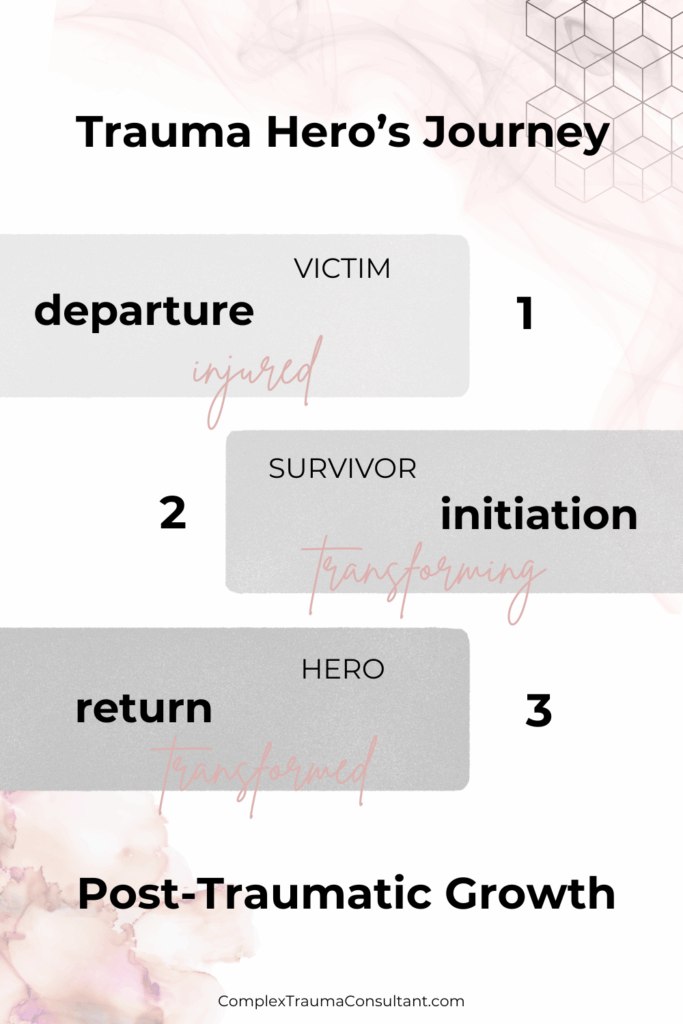
There are three stages of trauma processing, with the final stage representing post-traumatic growth:
- Victim [injured]
- Survivor [transforming]
- Heroine/Hero [transformed]
A victim is someone who has experienced trauma, complex or otherwise. People in the victim stage are typically still in shock or denial and haven’t truly begun to process. Depending on the trauma, people can stay stuck here for decades. A survivor is someone who has started feeling what there is to feel–shame, pain, and anger. A trauma heroine (or trauma hero) has surrendered to all of it, metabolized the entire experience, integrated the trauma into their worldview, and undergone post-traumatic growth.
In an academic paper called Trauma Recovery: A Heroic Journey, the authors compare the process of recovering from trauma to Joseph Campbell’s “hero’s journey:”
Stage One (The Departure) begins with some life circumstance that serves as a ‘call to adventure’ that will require courage to accept. It is not uncommon for the traveler to initially refuse the call due to a fear of potential dangers. The encouragement or inspiration of a ‘mentor’ provides ‘supernatural aid’ in the form of resources and guidance, which is often the impetus needed for the would-be hero to find the courage to leave behind all that is familiar and embark on an unknown journey (Campbell, 1949, p. 49-90).
Stage Two (Initiation) is characterized by a series of trials, tests, ordeals, and victories. As the individual wrestles with each new challenge, she learns to rely on new allies and develops personal abilities. Each obstacle serves to strengthen and transform the traveler. This stage is often characterized by a final challenge that feels like a death from which the traveler emerges ‘reborn’ as a hero with enhanced strength, wisdom, and knowledge.
In Stage Three (Return) the transformed hero is beckoned to re-enter the ordinary world with gifts of enhanced wisdom and knowledge bought through her experiences. Perhaps reluctant at first, the hero is summoned from the extraordinary journey back to the life of the ordinary. This return often involves another life and death moment for the hero. Once achieved, she is now the ‘master of two worlds’ (Campbell, 1949, pp. 229-237) as she passes the threshold back to her community.
“Campbell (1949) describes the transformed hero’s increased wisdom, strength, inspiration or other resources as elixir which can be used to bring restoration to the world. The hero has come full circle and now serves as an aid to others as they begin their journey. Her personal journey becomes an offering of inspiration and hope in the service of others.” 2
Post-Traumatic Growth and PTSD Statistics
“The wound is the place where the Light enters you.” -Rumi
Psychologist Philip Zimbardo reports, “Having survived a disaster or personal trauma makes you three times more likely to be a hero and a volunteer.” 3 Obviously not everyone is post-traumatic growth hero material, and that is OK.
Nevertheless, the Recovery Village, reports that:
- 70% of adults experience at least one major traumatic event in their lifetime
- 20% of people who experience a traumatic event will develop Post Traumatic Stress Disorder (PTSD)
- In general, 1 in 13 people will develop PTSD at some point in their life. 4
The Phoenix Trauma Center says:
- 50% of children who experience trauma will develop PTSD
- Of the children and adults who develop PTSD, about 2/3 report experiencing post-traumatic growth.
Could we interpret this data to mean that only 20% of adults ever leave the victim stage of trauma recovery? And, of those, only about 70% graduate to post-traumatic growth hero?
 What Is Post-Traumatic Growth?
“You do vulnerability knowingly, or vulnerability does you.” -Brené Brown
In contrast to Post-Traumatic Stress Disorder (often the state of people in the survivor stage) or Complex Post Traumatic Stress Disorder (the matrix version of stage 2 or 3, depending), post-traumatic growth is the result of passing through the dark tunnel of PTSD. The person inching forward through the quicksand of the trauma often has no idea they are “growing” because they remain focused on emerging from the suffering.
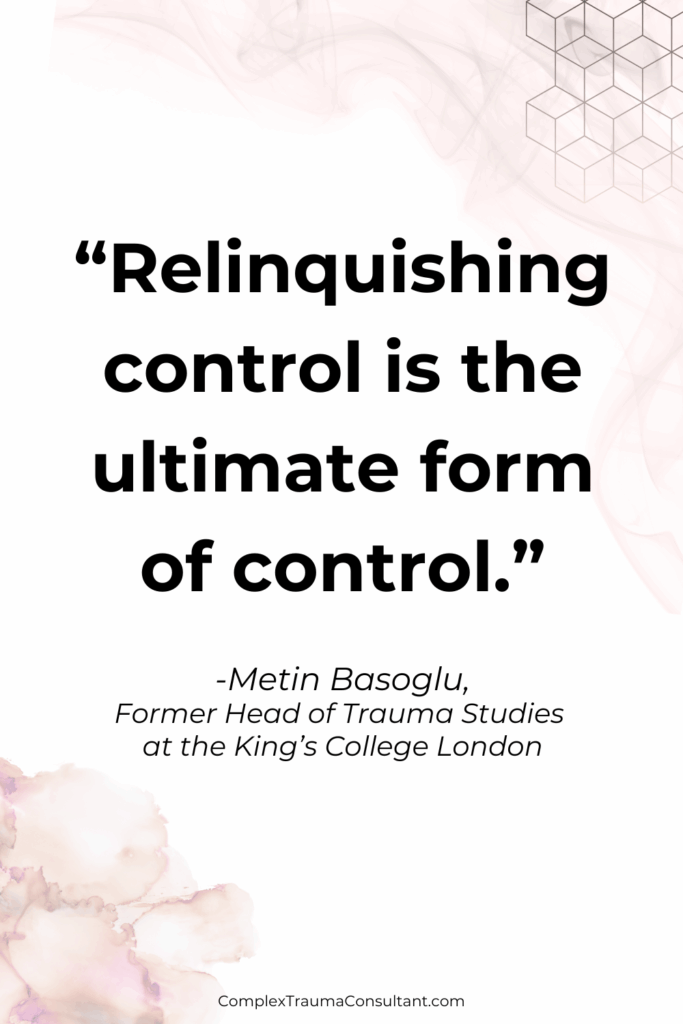
When it comes to moving through one’s trauma, Metin Basoglu, former Head of Trauma Studies at the King’s College London says, “Relinquishing control is the ultimate form of control.” 5 To move through complex trauma, survivors must let it push and pull them where it will. Because of this messy, unpredictable map for healing, it is common to not feel that any evolution has been experienced until well after graduating from the survivor phase. The new-found insights or awareness may not be apparent for a long time.
Positive Psychology breaks down post-traumatic growth into three categories:
- “Feeling stronger and finding hidden abilities and strengths; this changes the person’s self concept and gives them confidence to face new challenges, e.g. If I can survive this, I can survive anything;
- “Good relationships are strengthened, which is reflected in how people often speak of ‘finding out who their true friends are’ after they have experienced a trauma; and,
- “Priorities and philosophies concerning the present day and other people are altered, e.g. living for the moment and prioritizing your loved ones (Haidt, 2006; Joseph & Linley, 2005).” 6
Other sources report these post-traumatic growth components:
- emotional growth
- closer family relationships
- a better perspective on life
- greater self insight
- positively altered values and priorities
- appreciation of life
- personal strength
- spiritual change
In his ground-breaking book Complex PTSD: From Surviving to Thriving, therapist Pete Walker describes post-traumatic growth in great detail. He first explains the emotional intelligence aspect:
We live in an emotionally impoverished culture, and those who stick with a long term recovery process are often rewarded with emotional intelligence far beyond the norm. This is somewhat paradoxical, as survivors of childhood trauma are initially injured more grievously in their emotional natures than those in the general population.
The silver lining in this, however, is that many of us were forced to consciously address our suffering because our wounding was so much more severe. Those who work an effective recovery program not only recover significantly from emotional damage, but also evolve out of the emotional impoverishment of the general society. One of my clients described this as becoming ‘way more emotionally intelligent than the normies.’
Perhaps the greatest reward of improved emotional intelligence is seen in a greater capacity for deeper intimacy. Emotional intelligence is a foundational ingredient of relational intelligence–a type of intelligence that is also frequently diminished in the general populace.” (p. 80)
Walker also zeroes in on enhanced capacity for intimacy as a common aspect of post-traumatic growth:
Intimacy is greatly enhanced when two people dialogue about all aspects of their experience. This is especially true when they transcend taboos against full emotional communication. Feelings of love, appreciation, and gratitude are naturally enhanced when we reciprocally show our full selves–confident or afraid, loving or alienated, proud or embarrassed. What an incredible achievement it is when any two of us create such an authentic and supportive relationship! Many of the most intimate relationships that I have seen are between people who have done a great deal of freeing themselves from the negative legacies of their upbringings.” (p. 80-81)
Finally, Walker explains in detail, based on his experience counseling complex trauma survivors, exactly how trauma can ultimately improve one’s internal life:
A further silver lining in recovery is the attainment of a much richer internal life. The introspective process, so fundamental to effective recovery work, eventually deepens and enriches survivors’ psyches. Ongoing mindful exploration of all aspects of our experience helps us see firsthand what Socrates meant when he said: ‘The unexamined life isn’t worth living.’ The survivor who follows the introspective ‘road less traveled’ becomes increasingly free of compulsive and unconscious allegiance to unhelpful familial, religious, and societal values that were instilled at an impressionable age. The recoveree now gets to choose her own values and reject those that are not in her own best interest. She develops a deeper, more grounded self-respect that is not contingent upon going with the herd and shifting center with every new popular trend. In psychological parlance, she becomes free and brave enough to individuate and develop more of her full potential.
In Joseph Campbell’s words, the survivor learns to ‘follow his own bliss.’ He is freer to pursue activities and interests that naturally appeal to him. He evolves into his own sense of style. He may even feel emboldened to coif and dress himself without adherence to the standards of fashion. He may extend his freedom to into his home decor. In this vein, I have seen many survivors discover their own aesthetic, as well as an increased appreciation of beauty in general. How this contrasts with many of the homes of my ‘normal’ sports buddies, whose homes are often sparsely decorated, as if they are too afraid to put something out or up lest it not be cool enough.” (p. 81)
Some argue changing the term Post-Traumatic Stress Disorder, which sounds like a disease, to Post-Traumatic Stress Injury since this term more accurately reflects the perfectly natural psychological bruising of being slapped with trauma. This re-definition would help shift the perception that PTSD is a normal, healthy process (Stage 1 or 2) rather than a mental illness.
Own It. Make Space. Tell Trauma Stories.
“Brave leaders are never silent around hard things. Our job is to excavate the unsaid…That requires courage and vulnerability.” -Brené Brown
In an article called “The Secrets of Extraordinary Survivors,” the author describes a female activist in the Congo who was kidnapped by the opposing political regime, raped, and tortured for 3 days. They left her bleeding and disoriented on the side of the road, and, weeks later, she discovered she was pregnant. She says, “Before my treatment, I wasn’t able to tell my story to anyone. I was dead. Now I feel like telling it. It’s my story.” 7
If processing my own childhood rape and complex trauma taught me anything, it’s that nobody wants to hear about it. Not really. But I told them anyway. Because I needed to. The more uncomfortable people I encountered, the more I realized how very, very needed these painful, awkward, raw, real conversations about rape and complex trauma are.
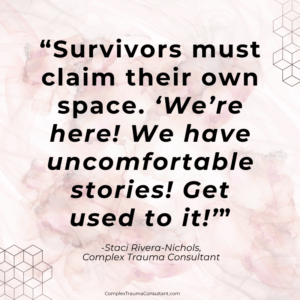
There is almost no space to discuss these sticky topics: afternoon talk shows, group therapy sessions, and in relation to a piece of news–that’s it! If you bring it up outside these acceptable situations, then you have “poor boundaries” and “overshare.” People going through complex trauma need more space to process, grieve, and digest than just this, so, until then, survivors must claim their own space. “We’re here! We have uncomfortable stories! Get used to it!”
The Harvard Medical School studied a group of people for 20 years who were hospitalized as teenagers for psychosis. They followed the group through the early 90s. According to WebMD, “Psychosis is a condition that affects the way your brain processes information. It causes you to lose touch with reality. You might see, hear, or believe things that aren’t real. Psychosis is a symptom, not an illness.” 8 So PTSD or C-PTSD would definitely meet this definition.
Of this group of people Harvard studied, who went on to lead functional adult lives? “These survivors did not appear to possess any remarkable innate attributes. Instead, what set them apart was the way they framed the story of their illness and how they integrated it into their personal narratives.” 9
 The Search for Meaning
“When we are no longer able to change a situation, we are challenged to change ourselves.” -Viktor Frankl
Jewish psychiatrist Viktor Frankl was sent to the Theresienstadt concentration camp in 1942. There he witnessed his father starve to death. In 1944, he and his family were moved to the Auschwitz concentration camp. He suffered the loss of both his mother and brother in the gas chambers there. Later, he and his wife were transferred to the Bergen-Belsen concentration camp. He watched his wife die of Typhus there. In total, Frankl spent three years in the Nazi concentration camps surrounded by the worst suffering and complex trauma imaginable.
When Frankl wrote a book about his experience, what did he call it? Man’s Search for Meaning. Sexist language aside, the title is basically, “Why does bad sh*t happen to good people?” Without coming up with an answer to this impossible question, most victims can never graduate to post-traumatic growth.
Survivors are compelled to literally unravel the universe to search for this meaning. The answer is typically tied up in things as deep as universal energy, one’s life purpose, a thorough study of multiple disciplines, and often an explanation to every other “why” out there. The process of post-traumatic growth is little less than deconstructing the universe from atom to cosmos.
Furthermore, no one can thrive as a complete, functional, vibrant human in a world where terrible tragedies and complex traumas just fall out of a clear blue sky. A world like that doesn’t feel safe. Stephen Joseph, a psychologist from the University of Nottingham says, “Trauma creates a rupture in a person’s life story.” 10 The only way to seal the rupture is to understand why the bad thing(s) happened. Dissecting “why” means post-traumatic growth.
What’s the first thing people say after trauma? “I didn’t think bad things like that could happen TO ME.” Because believing that is what helps us get out of bed everyday. Living in a world where bad things don’t seem “regular” is required to function. The only way to re-claim that feeling of safety after complex or any kind of trauma is, as Frankl says, to search for the meaning.
Dealing with Trauma Spiritually
“That which you resist, persists.” -saying
In a live Q&A, a woman once asked Eckhart Tolle, author of numerous best-selling Buddhism/spirituality books, how to deal with the suffering she had experienced from being the victim of a crime. He said, “The important thing is the realization that there is in you a dimension that is beyond anything that could ever suffer.” 11
This is re-assuring, especially since so many trauma survivors are stripped down to nothing more than our bare energy during the trauma. Tolle then points out the importance of not identifying with the pain. While, yes, the pain is present, the pain is not who we are. He also recommended surrendering to the pain because what we resist persists.
For example, after a flashback, one might say, “OK pain, here you are again. I acknowledge you. I see you. I feel you. I am me, and you are you. You are not who I am. For right now, you will be with me. That’s ok. I accept your presence at this time.” Telling one’s self this kind of story, this self-narrative, will help avoid losing touch with that un-bruisable inner element. Not surprising, Tolle’s wisdom is a product of post-traumatic growth as he characterizes his own childhood as being traumatic.
Additionally, in Neale Donald Walsh’s series of Conversations with God books, the message is that the purpose of life is not to “learn lessons.” We are consciousness. (This is not “new age hoo ha” any more–this is a fact easily proven over and over by quantum physicists.) Consciousness already knows what there is to know. Consciousness is awareness and infinite knowledge. We are not here in human form to learn. Earth is not a school. We are human BEings (not human DOings). We are here to BE who we are.
What does that mean? After George Floyd was killed, for example, due to a police officer kneeling on his neck during Covid-19, were you angry and protesting in the streets? Were you on your couch reading the social media posts thinking, “How awful”? Did you turn to meditation and visualize healing, safety, and love for Black Americans? Did you argue that “All Lives Matter”? Did you turn the channel because you’re not “political”? Did you donate to a bail fund? Did you cry? Everything that happens to us is an opportunity to express our “being-ness.” In the face of trauma or joy or failure or receiving love, who are you?
 How an Integrated Trauma Story Becomes Post-Traumatic Growth
“Be not afraid of growing slowly; be afraid only of standing still.” -saying
Getting back to one’s “story of trauma,” any spiritual teacher will advise people not to put energy on “your story.” For example, Alcoholics Anonymous philosophy discourages members from identifying with their stories of alcoholism. The ego loves to identify as a “poor me” victim. It loves complaining. A story of victimhood is the ultimate complaint for the ego. This is how trauma can lead us to post-traumatic growth–at the same time we need to compile “the story” in order to process and flush it from the system, we also need to avoid identifying as the story.
Ram Dass says, “In spiritual evolution, you don’t destroy the ego, you merely turn away from identifying with it, to having it as a functional unit.” 12 Our egos are wrapped up in our fight or flight responses. Ultimately, the ego wants us to survive and feel safe–it’s like a helicopter mom living in our heads.
Unfortunately, we only really, truly NEED the ego to “keep us alive” sparingly (god willing, right?). Post-traumatic growth is about walking that tight rope of, “I need my ego to help me survive this,” and, “OK ego, I don’t need you any more.” Dass says also, “…you really have to become somebody before you can become nobody.” 13 In the case of trauma, this means gathering and telling the story…until the need to express the story dissolves. This is post-traumatic growth, maybe even post-traumatic mastery.
From Zero to Hero: Claiming Post-Traumatic Growth
“I believe there’s a hero in all of us…” -May Parker in Spider-Man 2
Do you think after what Frankl survived at the hands of the Nazis that he felt his suffering could lead to post-traumatic growth? Absolutely. In fact, he believed in it so firmly that he created Logotherapy, defined by Wikipedia as “a concept based on the premise that the primary motivational force of an individual is to find meaning in life.” 14
Some therapists chastise this search for meaning as “intellectualizing;” however, I argue that having a framework of what the world is like is imperative for human functioning. This is why attaching to a healthy, nurturing mother figure is critical for human functioning–that imprinting is a map for what Chogyam Trungpa, author of Shambhala: The Sacred Path of the Warrior, calls “basic goodness.” It’s a “human programming” method that codes us to believe, “People are good. The world is a safe place.” When that understanding of reality is disrupted, reconstructing a new understanding is only human.
If you are currently dealing with PTSD or processing complex trauma, how can you help yourself keep pushing through to the other side? First, patience! Yes, you want to overcome this, but you must be gentle with yourself. Nevertheless, the more you can dive into what happened and feel it, the better. The main objective is to “get it out” of you. This will just be something that needs to get done until it doesn’t need to get done any more.
Personally, I made a “scrapbook” where I could craft my story page-by-page in full color with song lyrics, poetry, diary entries, academic essays, statistics, pictures, and all the room I wanted to be angry, sad, or hurt. I don’t know why I felt compelled to do it that way, but it was extremely healing, empowering, and rewarding. The trauma came “out” of me and went “on” the pages. Whenever I feel compelled to re-visit, I can open the scrapbook–an external thing, something no longer residing in me as it did before. Post-traumatic growth is reached when “the story” has been compiled, shared, released completely from every cell, then, eventually, set aside as to no longer be identified with.
Trauma Processing Tools
“Trauma is not what happens to you, but what happens inside you as a result of what happened to you.” -Dr. Gabor Maté
Victims will never be the un-traumatized versions of themselves again–it’s a new story to write. Aside from that, here are a few more tools to consider:
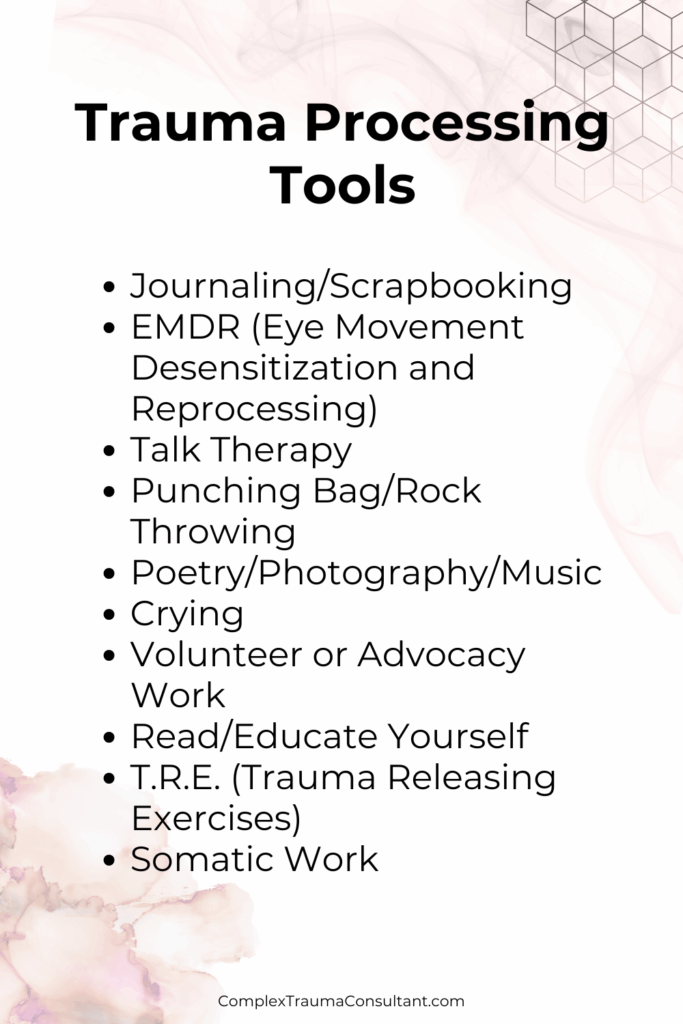
- Journaling/Scrapbooking – This is one of the most effective ways to “get it out.” Start writing everything you remember and feel. Analyze news events relating to your trauma. Write angry letters. Make a scrapbook.
- EMDR (Eye Movement Desensitization and Reprocessing) – This is a form of psychotherapy specifically designed to reduce the burden of traumatic memories. Your therapist will actually help you re-program your brain using a variety of tools: lateral eye movements, hand tapping, audio stimulation, etc. I personally have experienced benefits from EMDR.
- Talk Therapy – If you have not already sought out a trauma counselor to speak to, this will help tremendously to “get it out.” It is highly recommended to find a therapist who specializes in trauma (or even more specifically a rape trauma specialist or a veterans trauma specialist, etc) or else it is possible the therapist will do more harm than good.
- Punching Bag/Rock Throwing – Anger is a perfectly healthy reaction to trauma. The key is going to be finding a healthy way of getting that “out” as well. If you don’t have something you can punch, fill an old pillow sack with folded-up blankets or fabric, and hang it up somewhere at punching height. You can use a black marker to write or draw what you are angry at on the old pillow case. Throwing rocks at a wooden fence, a dirt bank, or into a lake is also a powerful anger release.
- Art/Poetry/Photography/Music – Tap into your creativity and “get it out” by expressing your emotions as paintings, poems, songs, or photos. Describing your anger, explaining your pain, and figuring how to best capture your PTSD feelings in an artistic way can not only be super therapeutic, but it can help you communicate your story more effectively.
- Crying – No better way to “get it out” than through what Pete Walker calls “healing tears” or what Dave Pelzer, author of A Child Called It, calls “purging.” You’ve no doubt already cried until your eyes hurt, but, if you haven’t, allow yourself that kindness.
- Volunteer or Advocacy Work – You can remind yourself of how far you’ve already come and how strong and empowered you still are by volunteering to help other victims (or a similar population you find to be relevant–like working with children if you were traumatized as a child). Advocating for other victims or relevant population can be very rewarding as well (political protest, boycott, letter writing campaign to the government, fundraising, marching in the streets, etc).
- Read/Educate Yourself – Learning everything there is to know about PTSD or your specific type of trauma can be very empowering. Read books, google all of your questions as they arise, watch Youtube videos on these topics, see what documentaries are available on the things you feel compelled to study relating to your trauma. Become an expert on what happened to you. Collect evidence. Investigate. Research. Own it. Claim it. (Look at you reading all the way to the end of this article!)
- Reclaim your Power – What else can you do to reclaim your power? Every situation is different. Can you get the perp arrested? Can you write an Op/Ed for your local paper about what the police did to you? Where can you file a complaint? Contact a lawyer and find out what rights you have (filing a lawsuit might be an option).
- T.R.E. (Trauma Releasing Exercises) – This is an innovative series of exercises that “shake off” deep muscular patterns of stress, tension, and trauma from the body. It activates a natural “vibrating” reflex that releases muscular tension & calms down the nervous system. This is a new therapy that is really starting to gain popularity. No side effects, nothing to lose by giving it a try.
- Somatic Work – To physically remove the imprint of trauma from your cells, an article entitled “Transmuting Trauma Through Somatic Practices” on Chopra.com recommends scanning your body several times a day to be aware of the sensations (is your chest always tight? are you constantly flexing your jaw?) What does your intuition tell you about these sensations? For example, I find my stomach clenched constantly. Intuitively, I know that even though it’s been 5 years since my mom last attacked me (when I quit speaking to her), my cells are stuck in a constant state of terror that I work on little by little, day by day. Once you identify where your body is storing the fear, the hurt, the shame, the heart ache, etc, Chopra.com recommends the Emotional Freedom Technique (“tapping”) to help alleviate it. 15
Again, the main thing all these tools have in common are that they are ways to get the trauma “out.” To this end, Frankl explains in A Man’s Search For Meaning:
When someone finds that it is their destiny to suffer, they will have to accept their suffering as their task; their single and unique task. They will have to acknowledge the fact that even in suffering they are unique and alone in the universe. No one can relieve them of their suffering or suffer in their place. Their unique opportunity lies in the way in which they bear their burdens…
Once the meaning of suffering had been revealed to us, we refused to minimize or alleviate the camp’s tortures by ignoring them or harboring false illusions and entertaining artificial optimism. Suffering had become a task on which we did not turn our backs. We had realized its hidden opportunities for achievement…Rilke spoke of ‘getting through suffering’ as others would talk of ‘getting through work.’ There was plenty of suffering for us to get through. Therefore, it was necessary to face up to the full amount of suffering…there was no need to be ashamed of tears, for tears bore witness that a person had the greatest courage, the courage to suffer. Only very few realized that…like the comrade who answered my question of how he had gotten over his edema, by confessing, ‘I have wept it out of my system.’ (Sexist language removed. p. 77-79)
 Trauma Therapists & Facilitating Post-Traumatic Growth
“Choose courage over comfort.” -Brené Brown
Even in the Secrets of Extraordinary Survivors article, it quotes a trauma therapist encouraging other trauma therapists to tell clients crap stuff along the lines of, “You need to put a shiny, hopeful bow on your story and talk about how you survived.” Trauma survivors that apparently didn’t get a gold star from this guy said things like: “I’m a prisoner of the past,” “I feel empty,” and “I’m not worthy.” 16
This lack of awareness is unfortunately common. If one never felt trapped, empty, or worthless because of their trauma, then, I have to ask, are they still breathing? This type of thinking reminds me of when my toxic, alcoholic mom, less than 24 hours after my dad died, told me something to the tune of, “You can cheer up now–it’s over” (referring to my dad’s excruciating battle with the world’s deadliest cancer). I told her, “No, mom, this is just the beginning. If I don’t smile for the next six months, it’ll be perfectly healthy and normal. That’s how grief works.”
In the victim stage of trauma, the survivor WILL BE broken–that is the very definition of trauma…acute, complex, or otherwise. If one is not broken, they are dissociated or weren’t traumatized–period. The “broken-ness” feeling may well last through the survivor stage as well–that’s Complex-PTSD.
Please resist the urge to “build up” a trauma survivor by telling them how strong they’ve become or congratulating their personal fortitude. Nobody wants that kind of burden–having to become a “Teflon cactus” to survive. Survivors want to relax and feel safe, not for our human-ness, i.e. the ability to fight or flight, to be applauded. This would be like celebrating someone who flinched when a ball was thrown at them suddenly. Work on your own acceptance of the fact that some stories do not have happy endings–period.
Additionally, some trauma therapists encourage survivors to sleep in the dark (with the light off) and do other things that are currently terrifying. I think those things resolve themselves as one starts getting the details of their story together and begins sharing it. Allow safety…if that means sleeping with the light on for now, do it. My own recovery did not come from having more nightmares, it came from new epiphanies, new connections, new awareness (i.e. moving deeper into my own “search for meaning”). To achieve post-traumatic growth, dig in and analyze/deconstruct what happened, feel every last inch of ugliness, and act accordingly upon emerging on the other side as a post-traumatic growth hero.
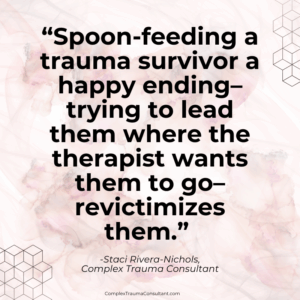
What trauma therapists can do, instead of trying to force or control a victim’s narrative, is to empower the person by allowing survivors to write their own stories–ones that are authentic, raw, ugly, messy. Spoon-feeding a trauma survivor a happy ending–trying to lead them where the therapist wants them to go–revictimizes them. Trauma is uncomfortable, disturbing. Remember: “We’re here! We have uncomfortable stories! Get used to it!”
Give options, not advice, and let the survivor make their own decisions. That is the only way post-traumatic growth happens. When you take power away from survivors–and that is exactly what trying to “clean up” someone’s narrative is–you’re no different than the person or event that took their power away in the first place. Don’t mess with survivors’ voices. God knows there were plenty of days when my story was: “I’m definitely not coming back to this therapist again!”
To put it in perspective, Dr. Brené Brown researches shame and vulnerability. She says, based on her research, that you can’t be loved if you can’t be seen. 17 Telling one’s unpolished story is imperative for being seen, being loved. If people can’t know the real truth of who they are, they’ll never own their trauma–it’ll own them.
Key Insights for Trauma Therapists
“Psychotherapy…[is] a profession whose mainspring is love. Nearly everyone who visits a therapist has a love disorder, and each has a story to tell–of love lost or denied, love twisted or betrayed, love perverted or shackled to violence.” -Diane Ackerman
Summary
Post-traumatic growth unfolds in stages: as victims, they first gather their trauma story, then, as survivors, they express and grieve that story, and finally, as trauma heroes, they integrate the experience into a new worldview. The therapist’s role is not to steer the narrative, reframe the pain, or tidy up the process, but to be a grounded, stable presence, offering consistency, care, and safety.
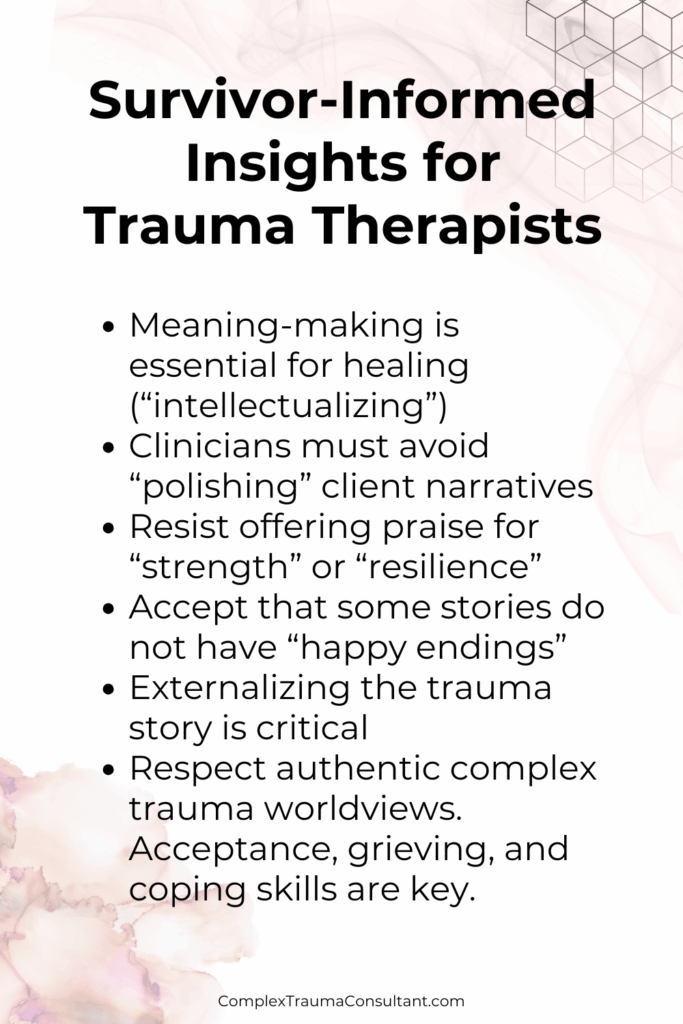
- Meaning-making is essential for healing: Clients often explore spiritual, philosophical, or existential frameworks to understand their trauma and re-establish a sense of internal order.
- Clinicians must avoid “polishing” client narratives: Pushing clients to reframe their trauma takes their power away and halts authentic processing. Your job is to facilitate the story, not direct it.
- Resist offering praise for “strength” or “resilience:” Clients don’t want to be congratulated for demonstrating fight or flight. Accept that some stories do not have “happy endings.” The goal is simply an authentic story.
- Externalizing the trauma story is critical: Methods like journaling, scrapbooking, somatic release, or EMDR help clients move the trauma story, once fully compiled, to them be purged or externalized.
- Emotional intelligence often emerges post-trauma: Therapists can witness profound growth in intimacy, spirituality, and inner strength among long-term survivors.
- Complex-PTSD worldviews: Sometimes after integrating their trauma story, a client’s perspective is that the world is a bad place and people are dangerous (a fair conclusion considered trauma was reprogrammed this client’s brain). Acceptance, grieving, and coping skills are key.
 Post-Traumatic Growth: In Conclusion
“People with heavy ‘pain bodies’ have a much stronger incentive to awaken spiritually than people with a very weak ‘pain body.’ So if your ‘pain body’ is dense and heavy, then be grateful…Enjoy the adventure of awakening in this lifetime.” -Eckhart Tolle
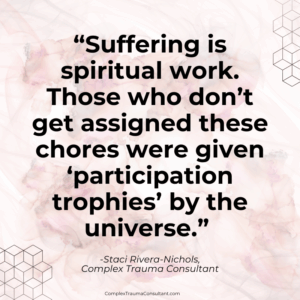
What are parents constantly complaining about with regards to the generation that got trophies just for showing up? It’ll make the kids “soft.” Most parents believe that you can’t talk to your kids about working hard, being responsible, or being strong. You give your kids chores, and work will teach them those things. Suffering is spiritual work. And those who don’t get assigned these “chores” in life were given participation trophies by the universe.
Yea, one might go 17 rounds against this mo-fo before the referee raises their glove over their head. But, when that moment happens, the trauma hero can be whoever they want. I truly believe that trauma, especially complex trauma, is a masterclass in conquering absolutely anything, which is something you can’t buy, learn from a guru, train for at Harvard, and study under a microscope.
Beating this thing is something that can never be taken away…and that is a power that only a blessed few get to experience. Finally, I’d like to close with one more quote from Dr. Brené Brown’s Netflix special The Call to Courage:
Here’s the thing–I’m not going to bullsh*t you. Vulnerability is hard, scary, and it feels dangerous. But it’s not as hard, scary, or dangerous as getting to the end of our lives and having to ask ourselves, ‘What if I would have shown up, what if I would have said I love you, what if I would have come off the [starting] blocks. Show up. Be seen. Answer the call to courage and come off the blocks–because you’re worth it. You’re worth being brave. 18
AI Usage Disclosure: This blog post was written analog-style by a human, but ChatGPT’s “SEO Assist” GPT offered assistance on formatting and generated much of the “key take-aways” section. For more information on how ComplexTraumaConsultant.com uses AI, contact the author. Also, feel free to read the site’s Privacy Statement.
PINTEREST PINS:
ComplexTraumaConsultant.com has a whole page of shareable quote images you can check out too.
THIS POST WAS WRITTEN BY:
Staci is a complex trauma consultant and trauma-informed marketing strategist for therapists. She helps organizations better reach and serve people living with trauma. With an ACEs score of 8, she speaks native trauma (vs. clinical trauma) and has 18 years of consulting experience. Currently earning her M.S. in Strategic Marketing, she has trained the US Marine Corps to better serve victims. Staci is a member of the Rape, Abuse & Incest National Network (RAINN) Speakers Bureau and holds certificates in victim advocacy, enmeshment trauma, and avoidant attachment. Request a free trauma-informed brand audit to learn more.
- https://en.wikipedia.org/wiki/Logotherapy
- https://scholarship.richmond.edu/cgi/viewcontent.cgi?article=1010&context=heroism-science
- https://greatergood.berkeley.edu/article/item/what_makes_a_hero/
- https://www.therecoveryvillage.com/mental-health/ptsd/related/ptsd-statistics/
- https://www.bbc.com/future/article/20150813-the-secrets-of-extraordinary-survivors
- http://positivepsychology.org.uk/post-traumatic-growth/
- https://www.bbc.com/future/article/20150813-the-secrets-of-extraordinary-survivors
- https://www.webmd.com/schizophrenia/guide/what-is-psychosis
- https://www.bbc.com/future/article/20150813-the-secrets-of-extraordinary-survivors
- https://www.bbc.com/future/article/20150813-the-secrets-of-extraordinary-survivors
- https://www.youtube.com/watch?v=dZ2GfrendQg
- https://www.ramdass.org/the-ego-dichotomy-fear-love/
- https://www.ramdass.org/healing-from-childhood-injury-as-a-prelude-to-spiritual-practice/
- https://en.wikipedia.org/wiki/Logotherapy
- https://chopra.com/articles/transmuting-trauma-through-somatic-practices
- https://www.bbc.com/future/article/20150813-the-secrets-of-extraordinary-survivors
- https://www.youtube.com/watch?v=gr-WvA7uFDQ
- https://www.youtube.com/watch?v=gr-WvA7uFDQ

