

Why Women Demonstrate PTSD Symptoms More Than Men
Author: Staci Rivera-Nichols – Complex Trauma Consultant
Read Time: 10-15 minutes | Publication Date: November 8, 2025
Watch It on YouTube
Key Terms Defined
- Fragile Masculinity: This term describes peculiar anxiety experienced by men who feel that doing certain things causes them to fall short of the societal ideal for manhood. Fragile masculinity can affect a man’s wellbeing, causing substance abuse, depression, suicide, aggressive posturing, mockery of “un-macho” behaviors, and on-going attempts to demonstrate dominance. Masculinity is not inherently fragile or toxic–these constructs are unhealthy adaptations of masculinity.
- Post-Traumatic Stress Disorder (PTSD): The National Center for PTSD says, “Post-Traumatic Stress Disorder is a mental health problem that some people develop after experiencing or witnessing a life-threatening or traumatic event. If symptoms last more than a few months, it may be PTSD.” While the DSM-IV defined PTSD as an anxiety disorder, the DSM-V categorized it under “trauma- and stressor-related disorders.” Also, the DSM-V proposes four diagnostic clusters of behavioral symptoms associated with PTSD: arousal, re-experiencing, negative cognitions, and avoidance. The term “Post-Traumatic Stress Injury” is preferred as it more accurately reflects the natural psychological bruising of being hit by trauma.
- Rape Trauma Syndrome: This is a subset type of PTSD specific to experiencing non-consenual sexual penetration.
- Toxic Masculinity: Toxic masculinity is a harmful set of traditional male behaviors, such as dominance, suppressing emotions, and aggression. These behaviors are damaging to both male-identified people and society as a whole. Toxic masculinity is a result of social pressures that link manhood to emotional stoicism, controlling others, and violence. Masculinity is not inherently toxic or fragile–these constructs are unhealthy adaptations of masculinity.
- Trauma: Dr. Gabor Maté says, “Trauma is not what happens to you, but what happens inside you as a result of what happened to you.
Gender Differences in PTSD
“I am no longer accepting the things I cannot change. I am changing the things I cannot accept.” -Angela Davis
Speaker and author Tony Robbins expresses a very typical “good ol’ boys” attitude whenever the subject or victimhood or PTSD arises. He told Opie Radio that people need to let go of negative emotions and problems. The interviewer says, “Is that suppressing the problem though?” Tony responded, “No, no, suppressing is pretending it’s not there…In any moment, what’s wrong is always available, but so is what’s right…You’re feeling like sh*t doesn’t help somebody else.” 1 Looking away from trauma doesn’t make it go away, nor is there a need to regulate our own emotions based on helping other people. These are really well-accepted, popular responses to trauma though…to kind of look the other way.
 For the most part, I like world famous life coach Tony Robbins’ attitude, purpose, and work ethic, and I respect the fact that literally millions of people around the globe say that he has helped them live better lives. Tony was severely abused by his mother growing up. In that way (plus, he was a speech & debate geek like me), I relate to him somewhat. He avoids, however, talking a lot about the abuse he suffered because he feels it makes him “look like a victim.”
Does Sharing a Trauma Story Equate to Victimhood?
“There are two powers in the world; one is the sword and the other is the pen. There is a third power stronger than both…that of women.” -Malala
It’s time for this narrative to change–sharing your story doesn’t make you “look like a victim.” Minimizing or silencing your story does. It’s more than OK to feel like sh*t after being traumatized. Yes, as someone who has C-PTSD and has had PTSD, post-traumatic stress that persists is a clear problem, but spending a few weeks or months in PTSD after a trauma is reasonable, if not healthy processing. One can both be grateful and thankful for a variety of things and still, at the same time, be angry, scared, and hurt about the trauma–this is a false distinction. In Chogyam Tronga’s numerous books about spiritual warriors, he says repeatedly that real warriors are tender and that vulnerability is where true strength comes from.
 How Men and Women Respond to Trauma
“Develop enough courage so that you can stand up for yourself and then stand up for somebody else.” -Maya Angelou
According to the National Alliance on Mental Illness, research indicates that men experience trauma 10% more often than women do. Despite experiencing less trauma, women are twice as likely as men to deal with PTSD. 2 Mental health researcher Dale Vernor hypothesizes that one reason for this is that men are dealing primarily with war/violence type of trauma, while women are dealing primarily with domestic violence and sexual assault. He reported that 94% of female sexual assault victims experience PTSD.
Vernor thinks another possible reason for this dichotomy is that PTSD is more prevalent in highly patriarchal societies. His final theory is that women experience PTSD more than men because of our female tendencies (i.e. 1. “tending to others”–I believe that’s called parenting…something dads are supposed to also do and 2. “women’s reliance on the support of others during problematic times”–because emotional support seems like a super unhealthy strategy?!??!). 3Wow! Speechless!
Let’s not tip toe around the pink elephant in the living room here, Mr. Vernor. “Toxic masculinity” and “fragile masculinity” are concepts for a reason. I’ve been raped. As a child. And then by two different men in adulthood. But war, to me, still seems worse. For one thing, war can include being raped (POWs and foreign objects, for example) plus all that pesky shooting, killing, bombing, seeing your friends die, and homesickness. It’s a big leap to assume rape is more PTSD-inducing than war simply because 94% of female victims get PTSD from it. Furthermore, boys and girls under 12 are molested at equitable rates…if those boys don’t process and express the trauma via PTSD, where does their trauma go? The National Library of Medicine reports, “A large proportion of male survivors are not likely to seek help.” 4
Fragile Masculinity and PTSD
“A woman is like a tea bag: You can’t tell how strong she is until you put her in hot water.” -Eleanor Roosevelt
I may be going out on a limb here, but I believe it’s harder for a man who has, for example, been sexually assaulted since he has to deal with everything a female victim experiences PLUS feeling like he’s not a “tough guy.” Women don’t feel like we aren’t “real” women after being raped. This argument is only further supported by Vernor’s second point about patriarchal societies producing more PTSD. Vernor only thinks about how patriarchy affects women, not how it also affects men.
Both “fragile masculinity” and “toxic masculinity” come from super patriarchal cultures. Men are demonstrating less PTSD because they stuff it down. Dissociation is not bravery. Looking the other way is not strength. Projecting a fake sense of OK-ness is not admirable. We can not ignore the high rate of suicide in men. The American Foundation for Suicide Prevention reported that, “In 2023, men died by suicide 3.8 times more than women. White males accounted for 68.13% of suicide deaths in 2023.” 5
 My Dad’s Story
“True champions aren’t always the ones that win, but those with the most guts.” -Mia Hamm
Beyond suicide, we must consider the long-term effects of dissociation as well. For example, my dad worked out religiously, ate health food as a hobby, never smoked or drank, and was 6’3″ and 180 lbs. at 50 years old…when he was told he had stage 4 pancreatic cancer and two months to live. No one could make sense of it. When I asked him why he thought this happened to him, he told me, “I spent my whole life being angry.” I’d maybe seen him angry twice in 30 years. More confusion…hmmm?!!?
Fifteen years after his death, I learned why he had been stricken with the world’s deadliest cancer. In the span of six months, I found out he’d been dishonorably discharged from the Marine Corps (He lived as a loud and proud marine with USMC bumper stickers and t-shirts and teaching us old boot camp cadences when we were hiking). Then I found out him and my mom had gotten pregnant at 15…something else they both completely buried.
But the real clencher was finding out that he’d been sexually assaulted in a campground at 8 years old. My dad’s friend raped me when I was 6 years old. I told my dad immediately after it happened. He didn’t even look at me. I had to ask, “Dad, did you hear me?” He said, “Yes,” and we did not talk about it again for 7 years. He never asked me if I was OK. No one did. I didn’t even know what had happened was considered rape. I had been completely abandoned by him. At any point, my dad could have told me I wasn’t alone, that he’d been attacked too. I ended up getting delayed-onset Rape Trauma Syndrome (i.e. rape-related PTSD) in college when I finally realized that what had happened to me was rape.
From the outside, my dad appeared to be extremely resilient. He had started a successful business, was a self-made millionaire, was well-respected by his employees, and really considered to be “a living legend” by everyone who knew him. But because I developed PTSD, I somehow didn’t tolerate childhood sexual abuse as well as he did?!!? Textbooks would say he’s resilient, and I’m not.
After I realized that what happened to me was rape, I sued the rapist and won. During my most acute PTSD symptoms, I went to NCAA Track & Field Nationals ranked dead last in women’s high jump…and finished in 3rd place, earning All-American accolades. With insomnia, intrusive thoughts, intense anxiety, and no appetite. With disruptive flashbacks surrounding me like a mine field. My dad, his own boss who made his own schedule, didn’t even show up to watch me compete. I asked my mom why he hadn’t come to watch. No reason.
But he’s the strong one? Holding it together on the outside should not be viewed as the only barometer for good mental health. It’s far more important to have it together on the inside.
 Key Insights for Trauma Therapists
“The best way out is always through.” -Robert Frost
Summary
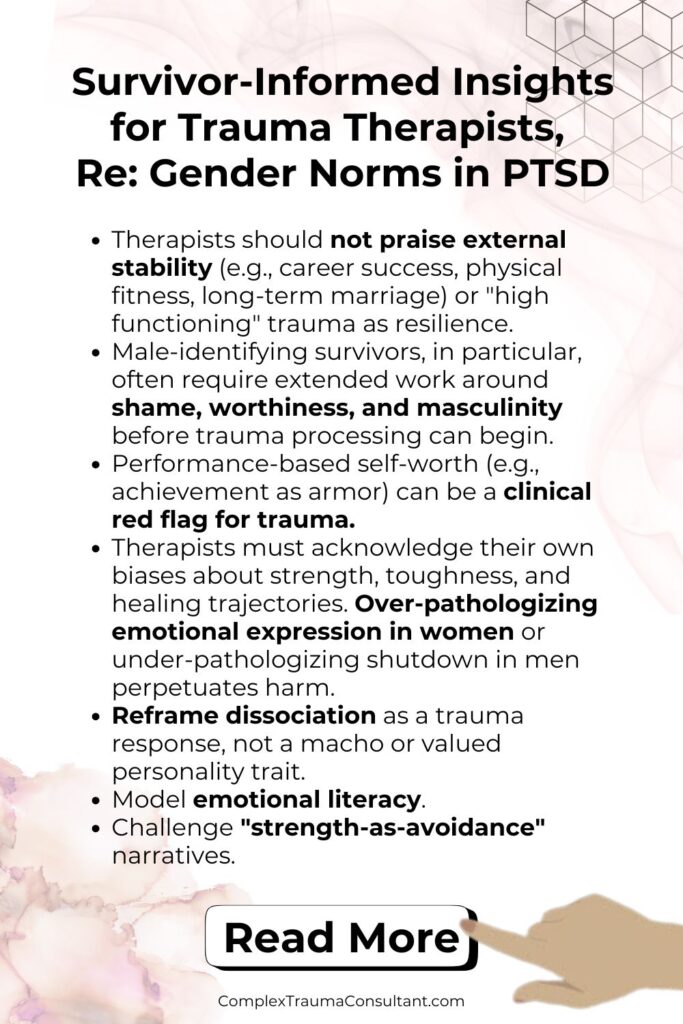
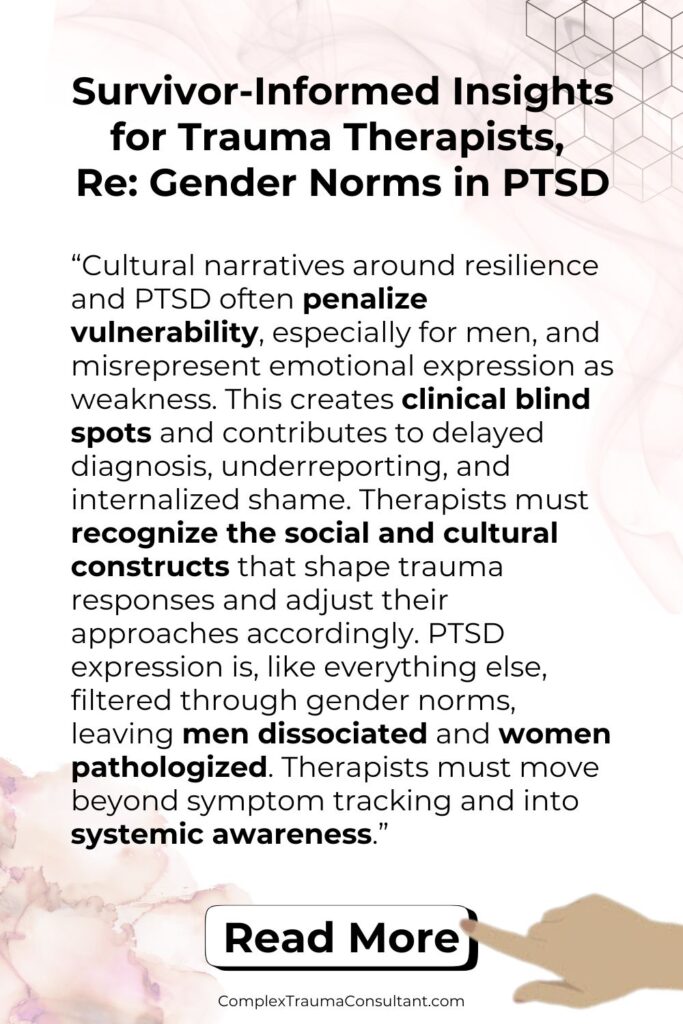
Cultural narratives around resilience and PTSD often penalize vulnerability, especially for men, and misrepresent emotional expression as weakness. This creates clinical blind spots and contributes to delayed diagnosis, underreporting, and internalized shame. Therapists must recognize the social and cultural constructs that shape trauma responses and adjust their approaches accordingly. PTSD expression is, like everything else, filtered through gender norms, leaving men dissociated and women pathologized. Therapists must move beyond symptom tracking and into systemic awareness.
- Therapists should not praise external stability (e.g., career success, physical fitness, long-term marriage) or “high functioning” trauma as resilience. It is not an accurate measure of internal regulation or trauma integration.
- Male-identifying survivors, in particular, often require extended work around shame, worthiness, and masculinity before trauma processing can begin. Again, male clients often interpret vulnerability as a threat to identity.
- Performance-based self-worth (e.g., achievement as armor) can be a clinical red flag for trauma, even when classic PTSD criteria are not present.
- Therapists must acknowledge their own biases about strength, toughness, and healing trajectories–we all have them, it’s human. Over-pathologizing emotional expression in women or under-pathologizing shutdown in men perpetuates harm.
- Use psychoeducation to reframe dissociation as a trauma response, not a macho or valued personality trait.
- Model emotional literacy: Many male clients lack language for emotional states. Use in-session mirroring, somatic tracking, and explicit labeling to help them build empowering emotional fluency without shame.
- Challenge “strength-as-avoidance” narratives: When clients minimize trauma (“I didn’t have it as bad as others”), help them de-center comparison and explore the functions of self-minimization. My dad used to say all the time that he had a “perfect childhood.”
Conclusion: PTSD Warriors
“Bring your whole self to the experience. Because the more we do that, the more that people get to see that, the more comfortable everybody’s gonna be with it.” -Bozoma Saint John
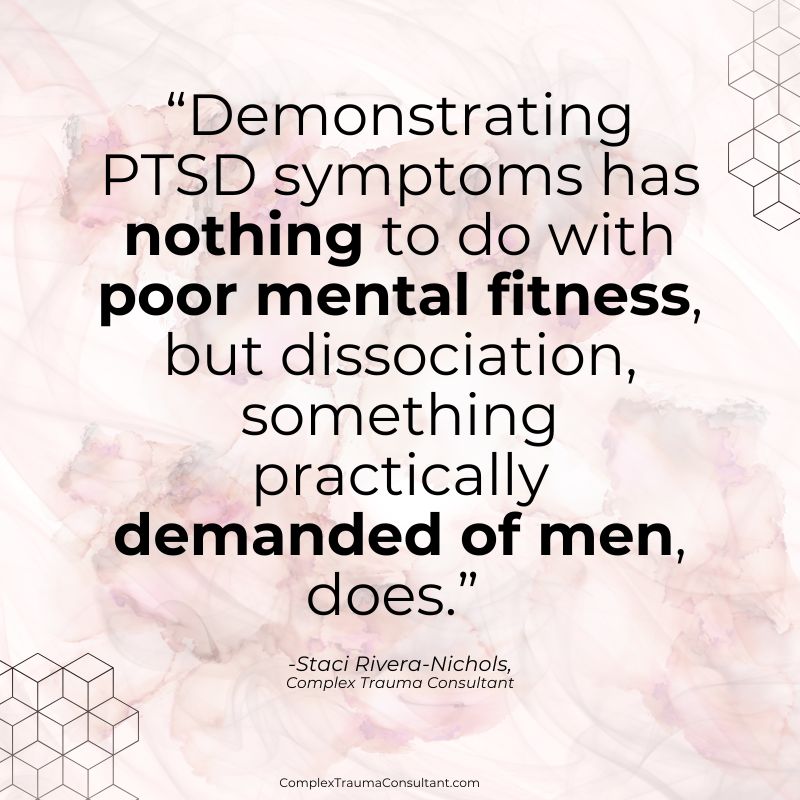
I say let’s give a round of applause to women who have the “hero factor” to actually feel the completely reasonable feelings associated with being traumatized, to those who will earn the steroid boost of “Post Traumatic Growth Hormone.” As Brene Brown says, vulnerability is courage, and courage is vulnerability. Demonstrating PTSD symptoms has nothing to do with poor mental fitness, but dissociation, something practically demanded of men, does. Becoming a “trauma hero” will cause you to develop mental and psychological muscles that are far more useful than physical muscles.
AI Usage Disclosure: This blog post was written analog-style by a human, but ChatGPT’s “SEO Assist” GPT offered assistance on formatting and generated much of the “key take-aways” section. For more information on how ComplexTraumaConsultant.com uses AI, contact the author. Also, feel free to read the site’s Privacy Statement.
PINTEREST PINS:
ComplexTraumaConsultant.com has a whole page of shareable quote images you can check out too.
THIS POST WAS WRITTEN BY:
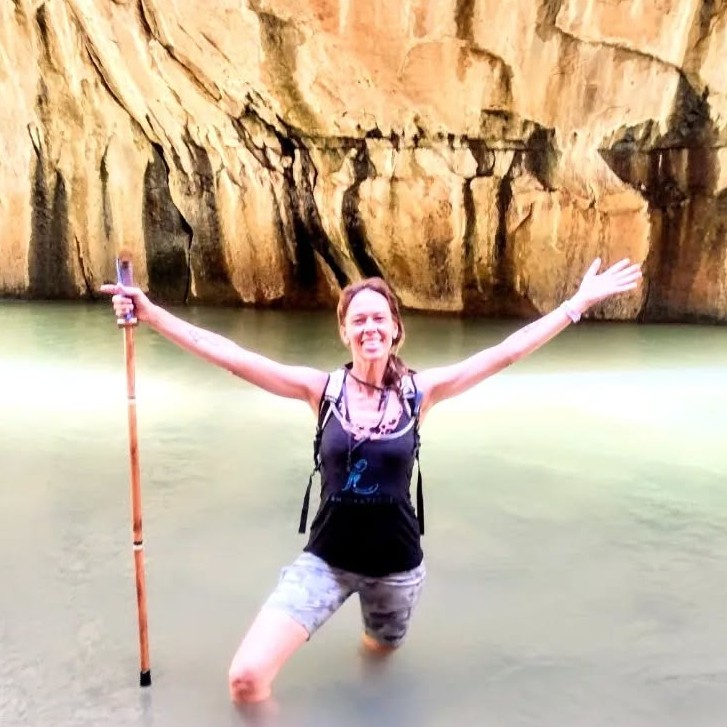
Staci is a complex trauma consultant and trauma-informed marketing strategist for therapists. She helps organizations better reach and serve people living with trauma. With an ACEs score of 8, she speaks native trauma (vs. clinical trauma) and has 18 years of consulting experience. Currently earning her M.S. in Strategic Marketing, she has trained the US Marine Corps to better serve victims. Staci is a member of the Rape, Abuse & Incest National Network (RAINN) Speakers Bureau and holds certificates in victim advocacy, enmeshment trauma, and avoidant attachment. Request a free trauma-informed brand audit to learn more.
- https://www.youtube.com/watch?v=zLozCh5oZLA
- https://www.nami.org/Blogs/NAMI-Blog/October-2019/PTSD-is-More-Likely-in-Women-Than-Men
- https://www.nami.org/Blogs/NAMI-Blog/October-2019/PTSD-is-More-Likely-in-Women-Than-Men
- https://pmc.ncbi.nlm.nih.gov/articles/PMC10414400/
- https://afsp.org/suicide-statistics/

