

Trauma, Peak Experiences, and Self-Actualization: Connecting the Dots
Author: Staci Rivera-Nichols – Trauma-Informed Marketing Strategist, Complex Trauma Consultant, and Marketing for Therapists Coach
Read Time: 9-12 minutes | Publication Date: November 3, 2025
Key Terms Defined
- Peak Experiences: Peak experiences (a.k.a. “God moments” or “being in the zone”) are intensely spiritual, profound moments in which time seems to stop. During a peak experience we experience our emotions more deeply and feel closely connected (to a lover, to nature, to God). The “peak experiences” concept was pioneered by Abraham Maslow and his pioneering work with positive psychology.
- Positive Psychology: PositivePsychology.com says, “Positive psychology is the scientific study of what makes life most worth living…a scientific approach to studying human thoughts, feelings, and behavior, with a focus on strengths instead of weaknesses, building the good in life instead of repairing the bad.”1
- Self-Actualization: PositivePsychology.com says, “Although self-actualization is most often associated with Maslow, the term was first coined by Kurt Goldstein. Goldstein characterized self-actualization as an individuation, or process of becoming a “self,” that is holistic (i.e. the individual realizes that one’s self and one’s environment are two pieces of a greater whole) and acts as a primary driving force of behavior in humans.”2
- Trauma: Dr. Gabor Maté says, “Trauma is not what happens to you, but what happens inside you as a result of what happened to you.”
What Are “Peak Experiences”?
“All lasting change happens in an altered state.” -Tony Robbins
Psychologist Abraham Maslow, father of the “peak experience” concept, pioneered the study of “positive psychology” by analyzing successful, functional people (unlike Sigmund Freud pioneered the study of dysfunctional people). One of the things Maslow discovered was that the people he studied seemed to all have had what he referred to as peak experiences.
Peak experiences, or what Brené Brown refers to as “God moments,” are rare transcendental pauses in life. Dave Pelzer, author of A Child Called It, calls these moments “tumblers.” Maslow believed these moments were more likely to be had by self-actualized people (or at least were more common among self-actualized people). 3 Peak experiences are intensely spiritual moments that one remembers forever, profound life-changing moments. They are considered to be powerful occurrences in which time seems to stop, in which we experience our emotions more deeply than ever, and one frequently feels closely connected (to a lover, to nature, to God, etc). Many top-level athletes refer to peak experiences as “being in the zone.” I like to think of THIS zone as the opposite of ‘the comfort zone,’ which never pushes us but only coddles us.
In Maslow’s book Toward a Psychology of Being, he observed these elements were reported again and again by people who claimed to have had peak experiences:
- Sense of Unity of the Self
- Oneness with the Environment
- Experience of Peak Power
- Not Forced
- Self Determination
- Free of Inhibition
- Spontaneity
- Purposeless Creativity
- Timelessness
- Pinnacle of Individuality
- Merging of Self and Other
- Unmotivated by Needs
- Artistic Expression
- Sense of Completion
- Playfulness
- Surprise Happenings 4
Maslow felt that peak experiences were positive and welcome. But what if we were to combine Maslow and Freud’s thinking?
Anyone who has survived trauma knows that traumatic moments are another kind of peak experience–they change our world views, are profound, and make us feel like we are in a vacuum while the rest of the world disappeared. On the other hand, traumatizing experiences are not necessarily more likely to be had by self-actualized people. But do they lay the groundwork for becoming self-actualized?
Understanding Self-Actualization
“When you are in the zone, your intuition comes to the forefront…your intuition will guide you. It is your best friend. It has information your mind does not have. When you are a zone performer–no matter what it is you do–you are operating on intuition, and you have an unfair advantage over the competition.” -Jim Fannin
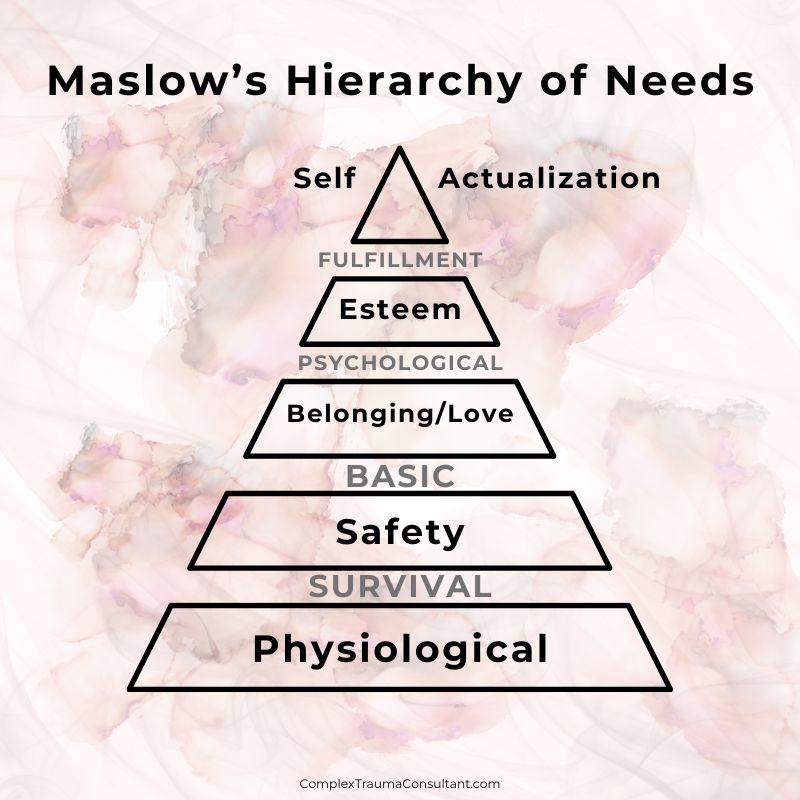
In Neale Donald Walsh’s Conversations With God books, he writes that the purpose of life is not to learn lessons but rather to self-actualize. The book describes it: “The purpose of life is not to please God. The purpose of life is to know and to re-create Who You Are.” In that vein, self-actualization is the process of realizing one’s full potential and being who you truly are in all moments–even the hard ones. As one’s most authentic self, this pinnacle is reached through psychological and spiritual development. This concept, also pioneered by Maslow, is understood as a lifelong journey and lies at the peak of his “hierarchy of needs” pyramid. Furthermore, self-actualized people are often empathetic, have perceptive, layered, and interdisciplinary understandings of reality, are deeply creative, have well-developed senses of humor, and accept themselves and others.
The elements of self-actualization are:
- Fulfillment and Satisfaction: Reaching this stage can lead to greater happiness, a sense of meaning, and contentment.
- Personal Potential: Rather than “fitting in” and meeting societal milestones or expectations, self-actualization involves understanding and fulfilling one’s purpose by using one’s unique talents.
- Social “Actualization:” Self-actualized people frequently possess strong senses of community responsibility and social concern, focusing on the well-being of the group as a whole and broader public threats.
Could Trauma Be a Peak Experience?
“One of the strongest signs of being ‘in the zone’ is a sense of freedom and of authenticity.” -Ken Robinson
It would be short-sighted not to wonder what brought the people Maslow studied to becoming self-actualized. The Wall Street Journal reported on a study of 400 extraordinarily high-achieving people and found that a disproportionately high number of them had experienced childhood trauma–75%! 5 While clearly not every abused child becomes a self-actualized “achiever,” many survive their situations by developing workaholic and perfectionist tendencies.
ProspectTherapy.com asks, “What makes some people thrive after trauma, and others shrink? What often happens, is that the more successful people become, the less worthwhile they feel. Meaning, there is a need to chase achievement (validation, financial success, safety) that never really ends. When you get to one milestone, you’re already setting your sights on the next one.” 6
On the subject of peak experiences, it can get complicated separating the various roots of one’s drive or motivation to pursue the path of self-actualization. This is why deconstructing yourself is the first step in this journey.
 Peak Experiences Are the Key to Self-Actualization
“It was a ‘God Moment’ that I shall never forget.” -Gayle Korczyk
In an academic paper entitled Trauma Recovery: A Heroic Journey, the authors write, “‘Rites of passage play a central role in preparing people to become emotionally, spiritually, and behaviorally ready for a heroic life’ (p. 3). Moving through the painful passage of trauma recovery may lead to improved functioning, psychological growth, and a deeper level of self–awareness (Bray, 2017).” 7 For those who process trauma like a peak experience, it may be seen simply as a rite of passage.
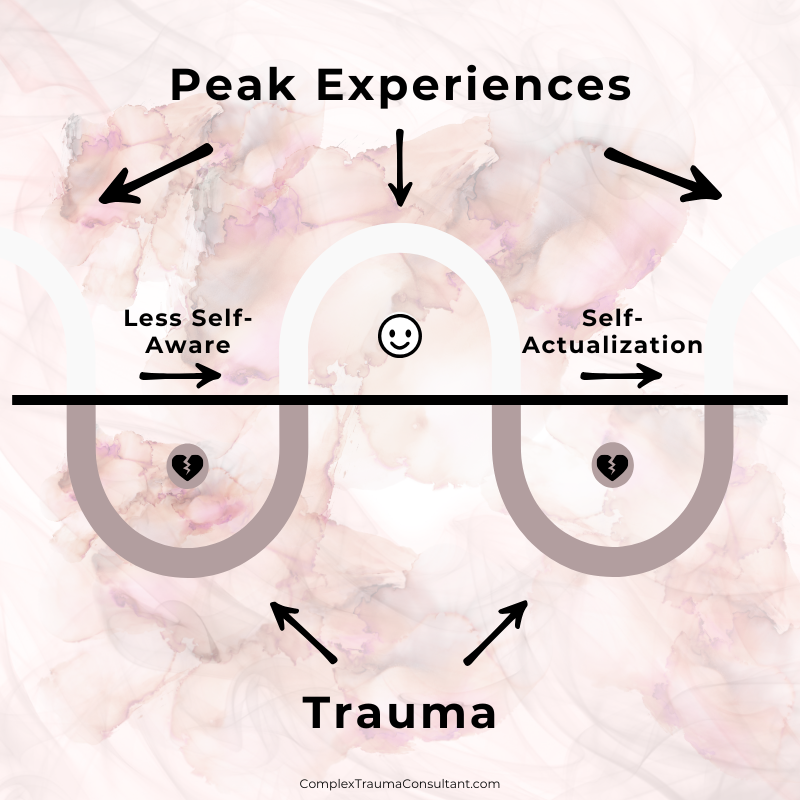
I propose another theory as well: are both positive and negative peak experiences the key to self-actualization? A person would risk not being well-rounded if their experiences were predominantly positive and privileged or overwhelmingly traumatic and negative. If climbing above the daily baseline of experience all the way to a peak is so transformative, why wouldn’t dipping below it to a trauma be just as transformative? I hypothesize that peak experiences are the positive versions of trauma and share many of the same groundbreaking or metamorphic powers.
For better or worse, because of the life-changing nature of peak experiences, they are a crucial element in moving people forward towards self-actualization. However, there are definitely things that people can do to cultivate experiencing more [non-traumatic] peak experiences. Take another look at the above list. For example, if one were to take up rock climbing (and, say, give up hanging out at the mall in its place), they are putting themselves in an atmosphere that is more likely to attract a peak experience (out in nature, challenging and trusting one’s self). Imagine the impact on the next generation if their mothers today were booking midwives for drug-free home births (pretty likely to be a peak experience) instead of asking for epidurals and elective C-sections.
 Curating Positive Peak Experiences
“Most traders believe that ‘getting into the zone’ happens when you have a hot streak. I believe you can create the zone. The zone is a psychological state. It is when you are focused, disciplined, and fully engaged in the process at hand…trading in the zone will certainly increase your capacity to perform and succeed.” -Ari Kiev
Maslow felt that one was more likely to have peak experiences if they frequently made space in their lives for them. One of the most important deterrents for having peak experiences is modern distraction–such as the interruption experienced by getting a cell phone notification. Open the door in your life for more peak experiences by challenging yourself physically and mentally, trying new things, traveling to places outside your comfort zone (different cultures, different languages, different places), setting aside off-the-grid time in nature, continually learning and studying, facing fears, doing hard stuff, etc.
A huge catalyst for having more peak experiences is believing in miracles. Breaking a new sports record or reaching the summit with a sprained ankle are miraculous things…and likely to be processed as peak experiences! Be aware of the reality of miracles! They happen everyday–seemingly impossible things.
Every night when you sleep, for example, you could play a subliminal recording to attract more miracles into your life. LiveScience.com reports, “Scientists do know that subliminal messaging works in the lab. Researchers inserted a dozen frames of a Coca Cola can and another dozen of the word ‘thirsty’ into an episode of the TV show The Simpsons. Participants reported being an average of 27% thirstier after the viewing than they were before, whereas the control group was slightly less thirsty afterward, according to a 2002 study published in the Journal of Applied Social Psychology.” 8 The bottom line is that subliminal videos are free on YouTube, and you have nothing to lose by giving them a listen.
Another way to allow more “breathing room” for peak experiences is with literal breathing room (i.e. meditation). As I was taught in Shambhala Level I training (the spiritual warrior sect of Buddhism), meditation allows my “mental dust” to settle so I can perceive the universe more clearly. The universe is trying to send us messages constantly, but, unfortunately, most of us are so imprisoned by our programmed reactions and incessant thinking that we rarely receive them. Meditation is the cure.
If you’ve never meditated, or have only done it a handful of times, let’s talk about why. Boring? The silence is deafening? The stillness is maddening? Too busy? You can’t stop your “monkey mind”? Well, I have news…spiritual warrior meditation (“Shambhala”) is supposed to be boring, maddening, & deafening! Silence and stillness insult the ego, and the ego is predominantly what blocks us from peak experiences (programmed reactions, constant thinking).
Reframe meditation as “training your mind.” This is why Buddhists say that they “practice Shambhala” or “practice mindfulness.” It’s no different than shooting hoops everyday to get better at basketball. Training our minds to be more receptive to peak experiences requires the same practice. It’s a discipline–mental exercise for spiritual fitness.
To do a Shambhala-style spiritual warrior meditation, sit upright in silence with your legs crossed on a small cushion on the floor or seated in a stiff chair with your feet flat on the ground. Let your hands naturally fall on to the top of your thighs and rest them there. Don’t lean on anything. Relax your jaw. Keep your eyes open and soften your gaze towards a spot in the room. Spend at least 10 minutes in this position focusing on your breathing (just breathing normally). When a thought intrudes or your mind wanders, gently redirect your focus back to your breathing. Engage with the simplicity of being present.
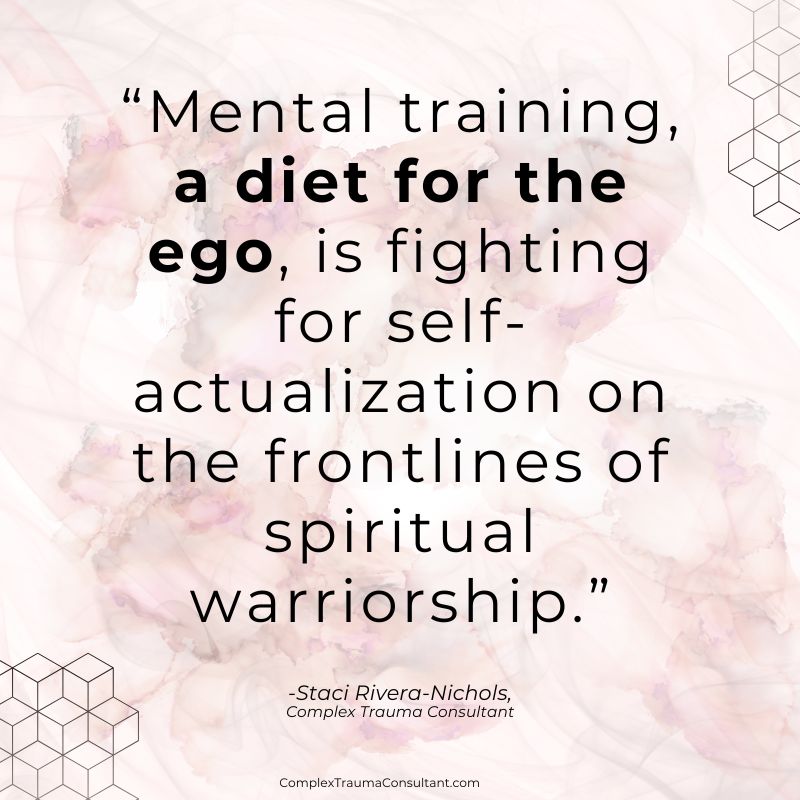
Today’s world is race pace. We have almost no relationship with stillness at all. T.F. Hodge said, “When you’re in the zone of your purpose with passion…time stands still.” Well, that’s what Shambhala meditation is: time standing still. The right mindset for peak experiences is programmed when you train your mind with stillness and silence–when you deny your ego it’s satisfying reactions and non-stop thinking…even just for a few minutes. Not only will spiritual warrior meditation help welcome in more peak experiences, but it has other self-actualization benefits. This type of mental training, an ego diet, is fighting for self-actualization on the frontlines of spiritual warriorship.
 Key Insights for Trauma Therapists
“The zone is a place that you rarely visit. It’s not some place you go every week. The zone is sacred ground.” -Joe Greene
Summary
By encouraging clients to fully process the emotional weight of both painful and profound peak experiences, trauma therapists can catalyze deeper self-actualization. Introducing practices that cultivate positive peak experiences empowers survivors to develop spiritual fitness—not just trauma recovery—which gets them further along the path to self-actualization.
- Consider having clients study Maslow’s concepts of peak experiences, self-actualization, and his hierarchy of needs for therapy homework. These can be powerful ideas to help with post-traumatic meaning-making.
- Self-actualization is about authenticity. Help clients explore their core self deeper than they may have ever needed to before.
- Chogyam Trongpa’s book on spiritual warriorship (Shambhala: The Sacred Path of the Warrior) can act as a guide through a client’s grief and layer-peeling–it’s like The Art of War but for trauma survivors interested in self-actualization.
Trauma as a Peak Experience Towards Self-Actualization?
“The trouble with life is we never know when we are ‘in the zone’ until we think back, with jealous longing, years later.” -Robert Black
While the after-effects of having a positive peak experience are, of course, pleasant and have many reported benefits, traumatic peak experiences seem just as likely to lead to self-actualization (referred to as “post-traumatic growth“). It all really depends on how the trauma is processed after it happens…will the survivor feel it fully, expel their grief, and work to heal the wound? Or will the survivor deny the significance of the event, say “Oh, I’m fine,” and avoid processing it? Socrates said, “The unexamined life is not worth living.” Peak experiences–good or bad–are one of, if not the most important, tools needed for self-actualization.
AI Usage Disclosure: This blog post was written analog-style by a human, but ChatGPT’s “SEO Assist” GPT offered assistance on formatting and generated much of the “key take-aways” section. For more information on how ComplexTraumaConsultant.com uses AI, contact the author. Also, feel free to read the site’s Privacy Statement.
PINTEREST PINS:
ComplexTraumaConsultant.com has a whole page of shareable quote images you can check out too.
THIS POST WAS WRITTEN BY:

Staci is a complex trauma consultant and trauma-informed marketing strategist for therapists. She helps organizations better reach and serve people living with trauma. With an ACEs score of 8, she speaks native trauma (vs. clinical trauma) and has 18 years of consulting experience. Currently earning her M.S. in Strategic Marketing, she has trained the US Marine Corps to better serve victims. Staci is a member of the Rape, Abuse & Incest National Network (RAINN) Speakers Bureau and holds certificates in victim advocacy, enmeshment trauma, and avoidant attachment. Request a free trauma-informed brand audit to learn more.
- https://positivepsychology.com/what-is-positive-psychology-definition/#:~:text=Key%20Insights%20%0A%20%20%20%0A%20,to%20improve%20overall%20life%20satisfaction%20&%20resilience.
- https://positivepsychology.com/self-actualization/#:~:text=Maslow%20posited%20that%20each%20level,World%27s%20Largest%20Positive%20Psychology%20Resource
- https://www.verywellmind.com/what-are-peak-experiences-2795268
- https://www.diygenius.com/peak-experiences/
- https://www.wsj.com/articles/the-secrets-of-resilience-1510329202
- https://www.prospecttherapy.com/blog/2018/10/29/do-traumatic-childhoods-create-high-achieving-adults
- https://scholarship.richmond.edu/cgi/viewcontent.cgi?article=1010&context=heroism-science
- https://www.livescience.com/does-subliminal-messaging-work.html

